
The Perverse Incentive Structure Driving ICE Under Trump’s Second Term
When Quotas Replace Judgment

A 65-year-old British tourist was shackled and held for six weeks despite a valid visa. Her guards told her agents are incentivized to detain as many people as possible. The data suggest they weren’t wrong, just imprecise about why.
Karen Newton is a 65-year-old British grandmother who spent the summer of 2025 doing what millions of international tourists do every year, driving through Yellowstone, watching Old Faithful erupt, spotting bison from a car window. She held a valid B2 tourist visa. She had no criminal record anywhere in the world. By September 2025, she was shackled at the wrists, waist, and ankles, transported through the night to a Montana border patrol station, and held for 45 days inside an ICE detention facility she describes as indistinguishable from a prison.
Her husband Bill’s visa had expired. Hers had not. ICE’s justification for detaining her: she had helped him pack, and was therefore “guilty by association.”
Her story, reported by The Guardian, is striking on its own terms. But its real analytical value lies in what it reveals about the incentive architecture now governing one of the federal government’s most powerful domestic enforcement agencies. When Newton asked guards why she was still being held after signing a voluntary removal agreement, multiple guards told her that agents receive financial incentives based on how many people they detain. ICE officially denies any such per-arrest bonus exists. Both things can be simultaneously true, and understanding why gets at something important about how bureaucratic incentive systems actually work.
The Principal-Agent Problem, Detention Edition
Principal-agent problems arise when the people executing a policy (agents) face incentives that diverge from the goals of the people who designed it (principals). The Karen Newton case is a near-textbook illustration of what happens when those incentives go badly wrong, not because any single actor is necessarily corrupt, but because the system architecture produces perverse outcomes as a predictable byproduct.
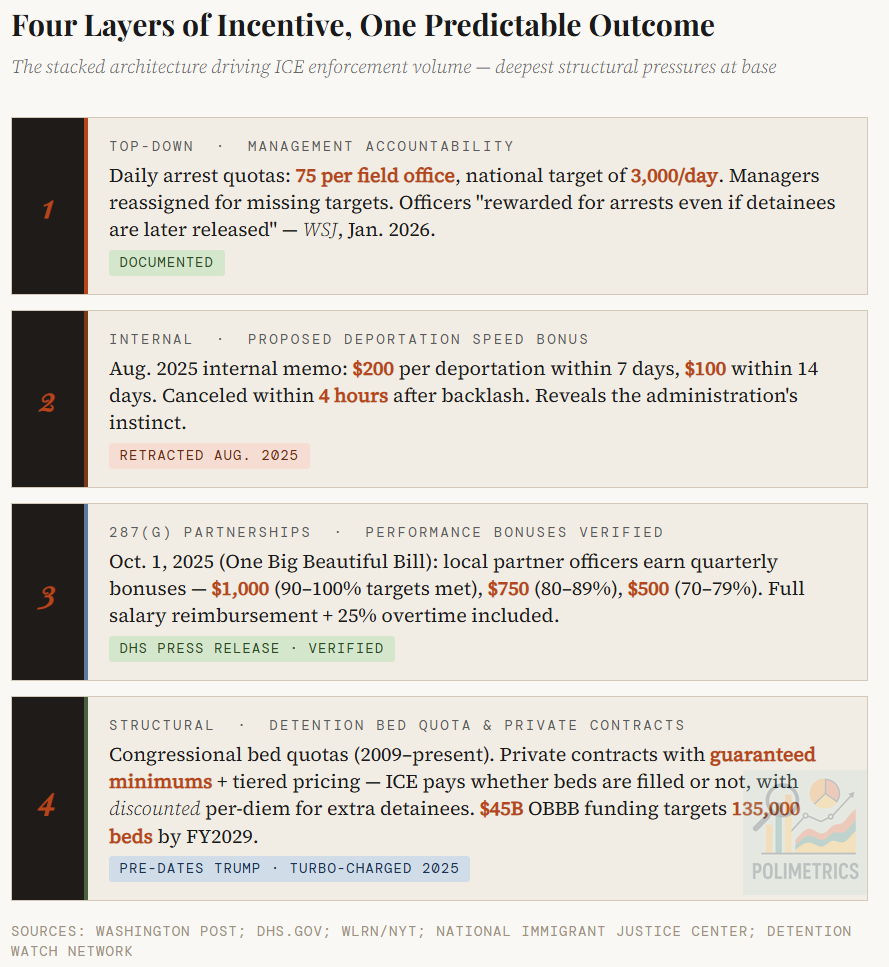
The incentive structure facing ICE under the second Trump administration is not a single mechanism but a layered stack of reinforcing pressures, each operating at a different level of the system. To understand why Karen Newton ended up shackled in a Montana cell despite a valid visa, you have to understand all four layers.
Layer 1: The Arrest Quota System
The most documented piece begins at the top. The Washington Post reported in January 2025 that field offices were directed to make 75 arrests per day each, with managers “held accountable” for missing targets. Stephen Miller went on Fox News in May 2025 and publicly stated the administration’s goal was “a minimum of 3,000 arrests per day” nationally, the number that would produce one million arrests in a year. In January 2026, The Wall Street Journal reported that officers “are under pressure from daily arrest quotas that leadership has set at 3,000 a day across the country” and that “officers are rewarded for making arrests, even if the immigrants they take in are later released.”
The WSJ was notably vague about the nature of those “rewards” and did not specify whether they were monetary. DHS told Snopes the per-arrest bonus claim “has never and never was in effect.” FactCheck.org and the Migration Policy Institute both concluded there is no verified per-arrest cash payment structure for federal ICE agents. This is worth being precise about: the specific claim Karen Newton’s guards made that agents receive money per head is unverified and may be wrong in its specifics.
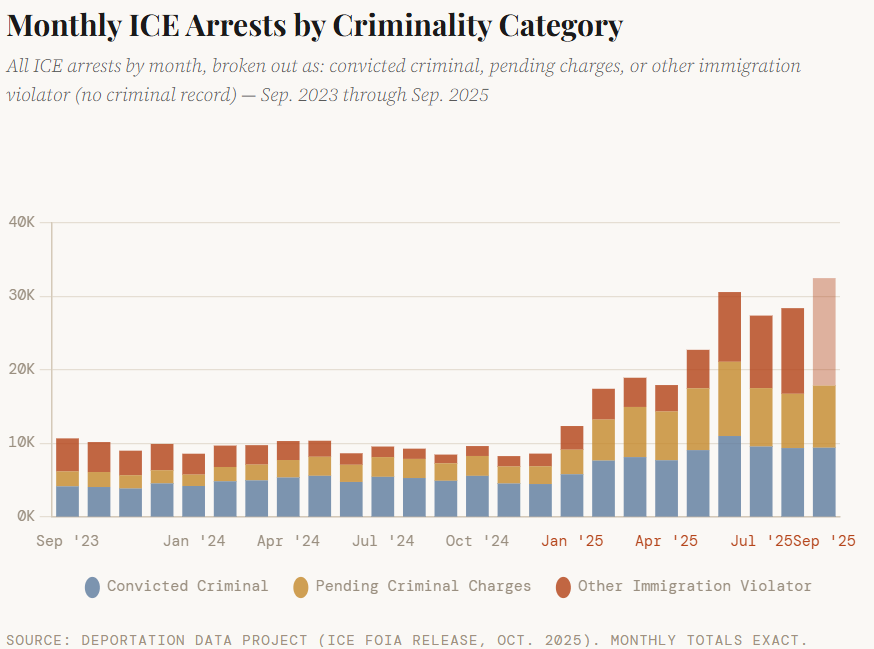
But the quota pressure is not in dispute. ICE has never come close to 3,000 daily arrests, but senior officials have been reassigned for missing targets. The Deportation Data Project documents arrests rising from a few hundred per day under Biden to over 1,100 per day by late 2025. The pressure is real. The behavioral response is measurable. The precise reward mechanism is just less clear than claimed.
Layer 2: The Brief, Revealing Deportation Bonus
In August 2025, an internal ICE memo proposed paying agents $200 for each deportation completed within 7 days of arrest and $100 for deportations completed within 14 days. The program was designed to reduce detention backlogs and “decreasing strain” on detention resources. It was canceled within four hours of being distributed to field offices, after a swift public backlash.
“That is so ungodly unethical. You can’t incentivize government agents to short-circuit people’s procedural rights. Would you pay a bonus to judges for wrapping up trials faster?”
— SCOTT SHUCHART, FORMER SENIOR DHS OFFICIAL
The program was never operational. But it functions analytically as a revealed preference, a window into the administration’s instinct about how to solve its deportation throughput problem. It also shows the administration was at least considering explicit financial incentives tied to speed of removal, and that it understood this would be seen as inappropriate enough to retract quickly. The gap between those two facts is instructive.
Layer 3: The 287(g) Partner Bonus Program — the Most Verified Piece
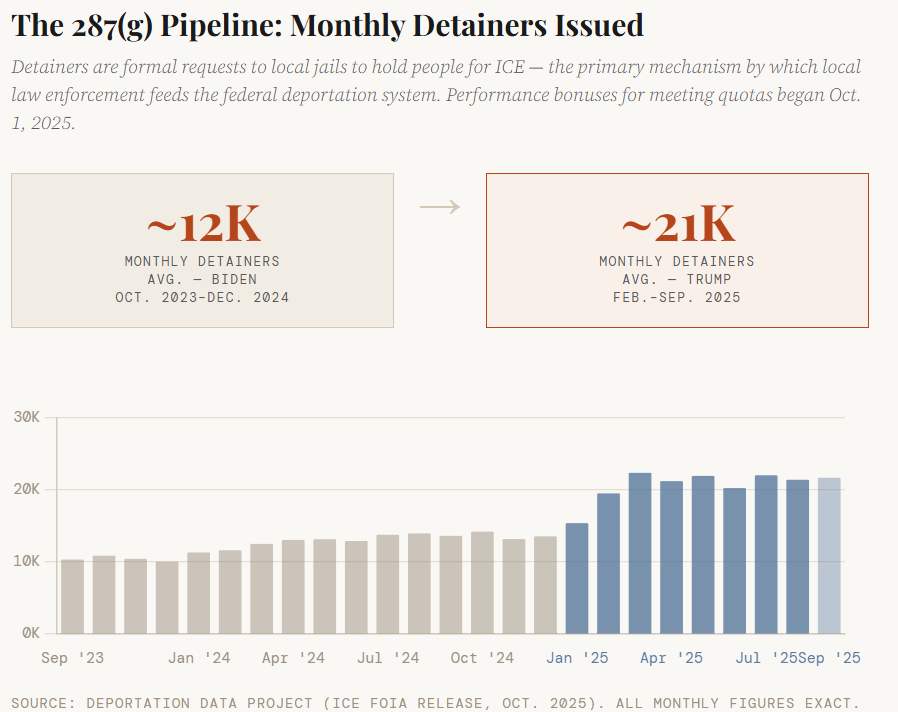
This is where the incentive story gets both more documented and, for anyone familiar with immigration enforcement research, more structurally significant. Starting October 1, 2025, funded explicitly by the One Big Beautiful Bill Act, DHS launched a tiered reimbursement program for 287(g) partner agencies: local law enforcement agencies deputized to assist ICE operations.
Under the program, ICE fully reimburses participating agencies for officer salaries, benefits, and up to 25% overtime. On top of that, agencies receive quarterly performance-based monetary awards based on how successfully they locate undocumented immigrants provided by ICE:
287(G) PERFORMANCE BONUS TIERS — DHS, EFFECTIVE OCT. 1, 2025
90–100% success rate: $1,000 per eligible task force officer per quarter
80–89% success rate: $750 per eligible task force officer per quarter
70–79% success rate: $500 per eligible task force officer per quarter
So while federal ICE agents may not receive a formal per-arrest cash bonus, the local officers deputized to assist them do receive performance-based financial incentives tied to locating immigration targets. This is in a public DHS press release. It is verified, operational, and significant, and it runs directly through the 287(g) program. My research shows these financial incentives introduced in October 2025 had a large impact on county-level adoption patterns of these 287(g) programs.
Layer 4: The Structural Bed Quota — The Deepest and Oldest Incentive
This layer predates the Trump administration entirely and is arguably the most important analytical piece because it operates regardless of who is in the White House. Starting in 2009-2010, Congress tied DHS appropriations to maintaining a minimum number of filled detention beds per day, initially 33,400, later 34,000. This created what policy researchers call a “bed quota”: a legal requirement to keep a certain number of people detained, embedded directly into the agency’s budget structure.
The mechanism goes further than the congressional mandate. Contracts between ICE and private prison operators (primarily CoreCivic and GEO Group) include guaranteed minimums. These are contractual clauses requiring ICE to pay for a set number of beds whether they’re filled or not. Many contracts also use tiered pricing that gives ICE a discounted per-diem rate for each person detained in excess of the minimum, meaning the marginal cost of filling an additional bed is lower than the average cost. The financial structure actively rewards higher detention volumes.
The Detention Watch Network describes the operational consequence plainly: “ICE agents are then encouraged to increase enforcement in order to maximize taxpayer dollars that are being spent to detain people.” This is not a political framing, it is a basic description of how fixed contractual costs create incentive pressure for field-level actors.
The One Big Beautiful Bill Act just poured $45 billion into expanding this system toward a potential 135,000 beds, nearly tripling capacity from the pre-Trump baseline. The American Immigration Council projects this funding is sufficient to operate that capacity through FY2029. The structural incentive to fill beds has never been larger.
75% INCREASE IN ICE DETENTION POPULATION, JAN–DEC 2025
(40K → 66K)2,450% INCREASE IN DETAINEES WITH NO CRIMINAL RECORD, JAN–DEC 2025
14:1 DEPORTATIONS FROM CUSTODY VS. RELEASES PENDING HEARING, NOV. 2025
Coercion as a Deportation Mechanism
Newton’s case also illustrates a second, related failure: the use of detention conditions as a coercion tool to generate “voluntary” removals that show up in the administration’s deportation statistics.
After three days in a Montana holding cell sleeping on a mat under a foil blanket — held, in her words, “chilled to the bone” — Newton and her husband signed a voluntary self-removal agreement under Project Homecoming. They were told it would expedite their return home. They waived their right to see a judge and accepted a potential 10-year ban from the United States. Newton received $1,000 as a “self-deportation payout.” Her husband received nothing. Then they were transferred to the Northwest ICE Processing Center in Tacoma and held for another six weeks.
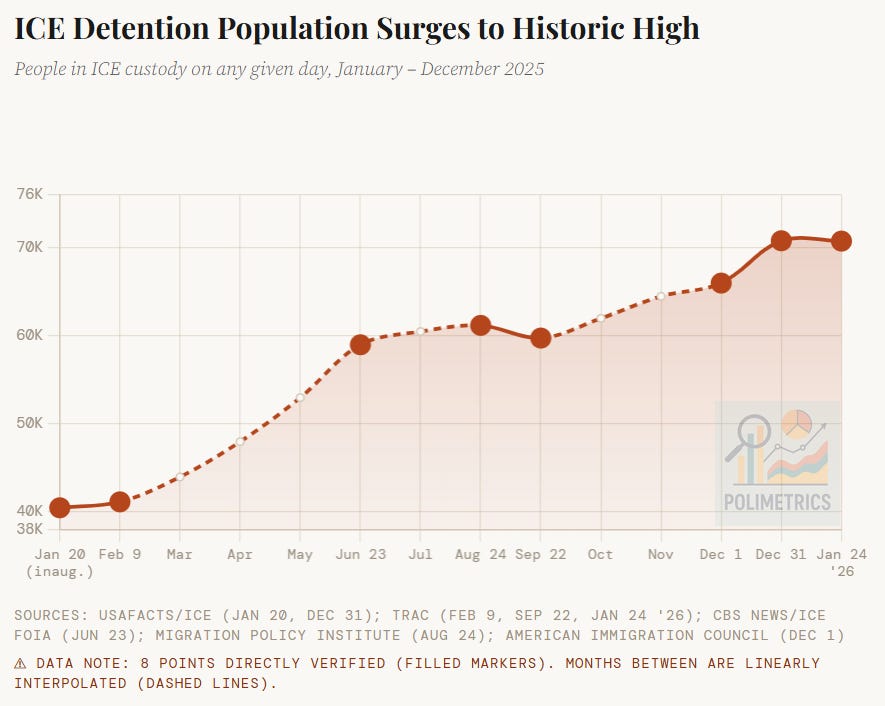
This is not an anomaly. The American Immigration Council’s December 2025 report documents that worsening detention conditions are explicitly functioning to pressure detainees into abandoning legal claims they might otherwise win. From January through November 2025, discretionary releases from detention fell by 87%. By November, immigration judges were approving bond at drastically lower rates.
The system is not designed to adjudicate cases fairly. It is designed to wear people down until they agree to leave.
“Prison would actually be better, because if you’re in prison, you get a sentence, they tell you how long you are going to be there.”
— KAREN NEWTON, ON HER DETENTION AT THE NORTHWEST ICE PROCESSING CENTER IN TACOMA
The Externalities Are Already Showing Up
One standard question in policy analysis is: who bears the costs of this incentive structure, and are they being counted by the people making decisions? The direct costs are visible and growing. More people died in ICE detention in 2025 than in any prior non-COVID year. Federal judges in multiple jurisdictions have issued orders demanding releases that ICE has slow-walked or outright defied. At least 170 U.S. citizens have been detained in raids or at protests. By January 2026, roughly 71% of ICE detainees had no criminal convictions. The Cato Institute’s David Bier, analyzing nonpublic ICE data, described the enforcement pattern as “indiscriminate.”
The indirect costs are slower-moving but potentially larger in aggregate. International tourism to the U.S. fell by 4.5 million visitors in 2025, with UK visits alone down 15%, costing billions in foregone revenue. Every Karen Newton story (a 65-year-old British grandmother with a valid visa, shackled and jailed for six weeks, urging tourists worldwide to avoid the United States) is a data point in the global mental model of what visiting America now means. These effects don’t show up on an ICE arrest report. They show up years later in booking data, conference placements, student enrollment figures, and trade relationships. They are the kind of diffuse, delayed, hard-to-attribute externalities that quota-driven bureaucracies are structurally blind to.
Newton’s warning when she said “I worry about young people going out there for the World Cup, I really do” is not hyperbole. It is a rational prediction from someone who has seen the system from the inside.
What the Evidence Actually Tells Us
The guards who told Karen Newton that “individual ICE agents get money per head” were probably not accurately describing a formal written policy. DHS has officially denied it, fact-checkers have been unable to verify it, and the Migration Policy Institute says it is unaware of any such structure.
But here is the more important analytical point: you do not need a formal per-arrest cash bounty to produce the behavior we are observing. The incentive structure at each of the four layers described above — management accountability for arrest quotas, $45 billion in sunk infrastructure costs creating pressure to fill beds, tiered performance bonuses for 287(g) partner agencies, and private prison contract structures that discount the marginal cost of additional detainees — produces the same behavioral result that a per-arrest commission would. The guards’ informal description was imprecise, but it was pointing at something real.
This is the standard logic of principal-agent theory applied to bureaucratic incentive design. When organizational rewards flow from quantity metrics rather than quality metrics, actors optimize for quantity. When the threshold for triggering rewards is lowered, actors lower their evidentiary standards. When the costs of errors fall on people who cannot push back through institutional channels, like non-citizens in detention or tourists who signed away their right to see a judge, those errors compound without correction.
Karen Newton wasn’t detained for 45 days because a single agent made a bad judgment call. She was detained because she was there, compliant, and countable inside a system that needed bodies to fill its beds, its quotas, and its contracts. Understanding that distinction is the difference between seeing her case as an isolated scandal and recognizing it as a predictable output of the policy architecture we have built.
Evidence-based immigration enforcement would define success as the removal of genuine public safety threats, measured against a clear statutory mandate, with accountability mechanisms that track wrongful detentions alongside deportations. What we have instead is a system where 41% of detainees have no criminal record, where a 65-year-old tourist with a valid visa can be shackled for six weeks, and where the official defense is that no formal bonus policy exists, as if the absence of a written per-arrest check makes the quota pressure any less real.
The incentives are the policy. Change the incentives and you’ll change behavior.
SOURCES & FURTHER READING
The Guardian — “Don’t go to the US”: Karen Newton, valid visa, detained by ICE for six weeks (Feb. 21, 2026)
Washington Post — Trump officials issue quotas to ICE officers to ramp up arrests (Jan. 26, 2025)
Wall Street Journal — ICE agents under pressure from 3,000-arrest daily quota; officers rewarded for arrests even if detainees released (Jan. 17, 2026)
DHS — New reimbursement opportunities for 287(g) partner agencies (Sept. 2, 2025)
American Immigration Council — Immigration Detention Expansion in Trump’s Second Term (Jan. 2026)
American Immigration Council — Report: Trump Immigration Detention 2025 (Dec. 2025)
Deportation Data Project — Immigration Enforcement in the First Nine Months of the Second Trump Administration
WLRN / New York Times — ICE offers, then quickly withdraws, cash bonuses for swift deportations (Aug. 2025)
FactCheck.org — ICE Officers and Bonuses (Feb. 2026)
FactCheck.org — As ICE Arrests Increased, a Higher Portion Had No U.S. Criminal Record (Jan. 2026)
Migration Policy Institute — Profiting from Enforcement: The Role of Private Prisons in U.S. Immigration Detention
National Immigrant Justice Center — Cut the Contracts: ICE’s Corrupt Detention Management System
Detention Watch Network — Detention Quotas
Prison Policy Initiative — New ICE arrest data show the power of state and local governments to curtail mass deportations (Dec. 2025)
Snopes — Do ICE agents get bonuses for arrests even if people are released? (Jan. 2026)
Axios — New data: ICE arrests surge as agency chases Trump quota (Dec. 2025)