
When Cutting Costs Isn’t Enough
What Two Classic Debates Teach Us About Government Efficiency and DOGE

In recent weeks, the Trump administration’s new initiative—the Department of Government Efficiency (DOGE)—has grabbed headlines. Led by Elon Musk, DOGE promises to trim billions in wasteful spending and reduce the federal workforce. But before we cheer (or protest) these bold moves, two classic debates in the academic field of public administration offer important lessons about what “efficiency” should really mean. One comes from Dwight Waldo’s timeless query, “Efficiency for what?” and the other from the contrasting ideas of Carl Friedrich and Herman Finer regarding how government should be run. Their insights remain crucial for understanding today’s reforms.
Waldo’s Big Question: “Efficiency for What?”
Decades ago, Dwight Waldo posed a deceptively simple question: “Efficiency for what?” Waldo argued that saving money is not the ultimate goal of government. Instead, efficiency must be a tool to improve public services and safeguard democratic values such as fairness, accountability, and public participation. For Waldo, the measure of efficiency shouldn’t be confined solely to dollars saved but should include the quality of services provided and the well‐being of citizens.
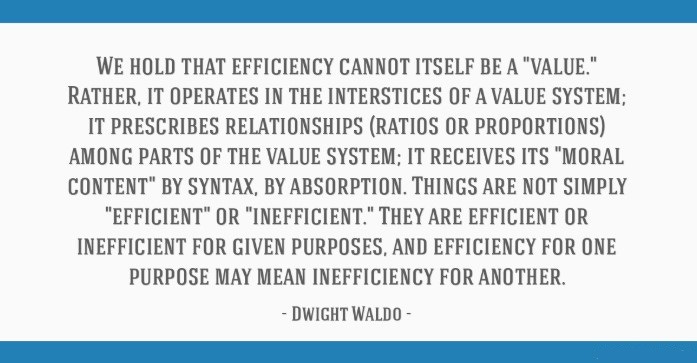
Imagine a public school system that slashes budgets to appear efficient—if these cuts leave classrooms understaffed and resources scarce, students ultimately suffer. Waldo warned that focusing only on the bottom line risks turning government into a cold, mechanical process that neglects its social and ethical responsibilities. In his view, efficiency must serve the public good. That means any cost-cutting measures should also enhance, not erode, the quality and accessibility of critical services like education, healthcare, and infrastructure.
Waldo’s insight becomes especially relevant in debates over initiatives like DOGE. While Musk boasts about “deleting waste” and trimming spending, Waldo would ask us to consider: Are these cuts really leading to better outcomes for citizens? Are they reinforcing democratic accountability and fairness, or merely reducing the size of government at the expense of essential public support? For Waldo, true efficiency is measured by how well government spending translates into tangible improvements in people’s lives rather than just tighter budgets.
The Friedrich–Finer Debate: Balancing Professional Judgment and Political Oversight
While Waldo challenged us to think about the ultimate goals of efficiency, the debate between Carl Friedrich and Herman Finer digs into how government decisions should be made. Emerging in the 1930s and 1940s, their discussion remains remarkably relevant today, especially in light of initiatives like DOGE.
Friedrich’s Perspective: Professional Responsibility
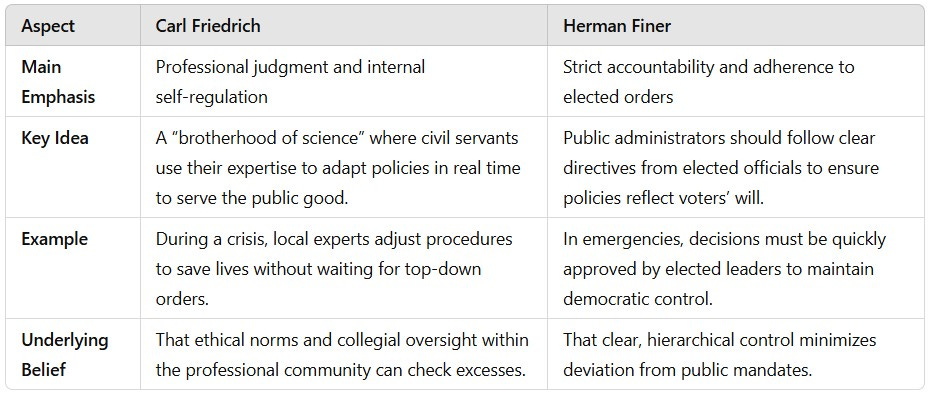
Carl Friedrich argued that public administrators—thanks to their specialized training and shared commitment to improving public welfare—should have the freedom to exercise professional judgment. He believed that civil servants form a community bound by common ethical norms and a deep dedication to public welfare. In Friedrich’s view, this community of experts is capable of self-regulation. They rely on technical knowledge, peer review, and mutual accountability to ensure that decisions made in the field are both effective and adaptable to local conditions.
For example, during a natural disaster, local administrators might understand that standard procedures need to be tweaked to address unique, rapidly evolving circumstances. Friedrich contended that such experts should be trusted to adjust policies on the fly—using their specialized skills to secure the best outcomes for the community. He maintained that this kind of responsibility goes beyond simply following orders; it involves proactively working for the common good. As Friedrich saw it, the “brotherhood of science” among public servants creates an internal check that can sometimes be more effective than external political oversight.
Finer’s Perspective: Clear Accountability to Elected Leaders
Herman Finer, by contrast, emphasized strict accountability. Finer argued that because elected officials are chosen by the public, they must have clear control over government actions. For him, accountability means that public administrators should follow the direct orders of elected leaders without veering into personal discretion. This approach is meant to ensure that government policies and spending reflect the will of the people as expressed through their votes.
Finer was concerned that if bureaucrats were allowed too much leeway, they might make decisions that, although technically sound, diverge from the priorities of the electorate. In his view, a clear chain of command is essential: elected officials decide what should be done, and administrators are there to implement those decisions exactly as instructed. This model of strict obedience minimizes the risk of bureaucratic drift and ensures that government actions remain firmly under democratic control.
The Nuanced Tension Between the Two Views
These two perspectives might seem like extremes, but in practice, they highlight a fundamental tension in public administration. Friedrich’s approach values the deep expertise and flexibility of professional administrators—a perspective that can lead to innovative and locally tailored solutions. However, critics worry that too much professional discretion might allow bureaucrats to pursue their own agendas, potentially drifting away from what voters expect.
Finer’s model, on the other hand, prioritizes clear, unambiguous accountability to elected officials, ensuring that government spending and policies align with public mandates. Yet, this approach can be rigid. When every decision must wait for top-down approval, responses to urgent, complex issues might become too slow or inflexible, undermining the very efficiency that is sought.
In today’s debates about government reform—exemplified by DOGE—these issues are front and center. Some observers argue that DOGE’s rapid, top‐down cost-cutting resembles Finer’s insistence on strict obedience, risking the loss of nuanced decision-making. Others worry that without strong accountability measures, administrative discretion could lead to unresponsive, self-serving policies that stray from the public interest.
Bringing It All Together: Lessons for Modern Government Reform
Both debates—Waldo’s and the Friedrich–Finer discussion—urge us to look deeper than mere budget cuts. Waldo challenges us to define efficiency by its ultimate purpose: to enhance the quality of public life. Meanwhile, the Friedrich–Finer debate forces us to consider the balance between trusting expert judgment and ensuring democratic control.
Imagine a scenario where a local agency must respond to a sudden crisis such as a flood. Following Friedrich’s model, administrators might swiftly adjust procedures to save lives by relying on their technical expertise. However, if such decisions bypass the direct oversight of elected officials, voters might feel that their interests are being overlooked. Conversely, if every adjustment must be pre-approved in a strictly Finer-like system, the response could be too delayed, potentially costing lives.
The challenge, then, is to strike a balance—allowing professional discretion when it is most needed while maintaining clear lines of accountability to the public. This balance is at the heart of modern debates over government reform, including the controversial efforts of DOGE.
As we observe initiatives like DOGE unfold, remembering these classic debates can help us ask the tough questions: Are the cost-cutting measures genuinely improving public services? Do they preserve the flexibility needed to respond to local challenges? And do they maintain a clear accountability to democratic leadership?
Ultimately, government isn’t just a machine to be trimmed down; it’s a complex system meant to serve people. By keeping in mind Waldo’s question—“Efficiency for what?”—and weighing the insights of Friedrich and Finer on professional responsibility versus strict accountability, we can better evaluate whether reforms are truly making government work better for everyone.