
When the Market Eats Itself
The market argument for religious freedom, followed to its conclusion

Religious institutions in the United States get a deal almost no other kind of organization gets. They receive tax exemptions. They are exempted from anti-discrimination rules, employment regulations, and financial disclosure requirements that bind nonprofits and businesses. Courts grant them wide deference to run their internal affairs as they see fit. The standard justification for all of this is a market argument, whether or not the people making it would put it that way.
The argument runs like this:
People choose their religion the way they choose anything else. They weigh what a denomination asks against what it provides, and they pick the bundle that suits them. Competition among denominations keeps the providers honest.
If a church asks too much for too little, members walk, and the church either adapts or shrinks. Government should stay out of the way, because the religious marketplace already disciplines bad actors better than any regulator could.
The deference, the exemptions, the hands-off posture all follow from this:
Members are free to leave, so whatever an institution does to them is something they have chosen to accept.
I find this argument useful for understanding the religious landscape in America. I also think that if you follow it all the way to the end, it stops shielding religious institutions and turns into grounds for scrutinizing them. That is the subject of a paper I have been finishing, and it is the conceptual floor for a line of thinking I want to keep developing here.
A word on intent, because this kind of analysis is easy to mistake for hostility. Most of my work is in state and local public finance and governance issues: how the safety net actually gets funded and delivered, from unemployment insurance trust funds to benefit adequacy to the tax structures underneath them. I am not coming at religion as something to tear down. I am coming at it as another institution that collects revenue, provides public goods, and serves people who depend on it, because there is a serious and growing argument that religious institutions should shoulder far more of the safety net than they do now. That argument deserves to be taken seriously, and taking it seriously means asking whether these institutions can actually carry that load.
The argument nobody names
The economics of religion is a real and productive research program. Laurence Iannaccone, Roger Finke, and Rodney Stark built it over three decades, and the core finding is robust: religious participation tends to be higher where religious markets are less regulated. Competition produces vitality. Strict churches, counterintuitively, are strong churches, because strictness screens out free-riders and concentrates commitment among the people who remain. Adam Smith said something close to this in 1776 about lazy established clergy versus hungry competitive ones. The modern version just put it in the apparatus of microeconomics.
That framework is a restatement of Tiebout’s model of local government.
Tiebout’s 1956 paper solved a problem in public finance. How do you provide local public goods efficiently when you cannot read people’s preferences? His answer was that you do not have to read them. You let people sort. Households evaluate the tax-and-service bundles different towns offer and move to the one that fits. Voting with your feet reveals what surveys cannot, and competition among jurisdictions pushes the whole system toward efficient provision. It is one of the most influential ideas in the field.
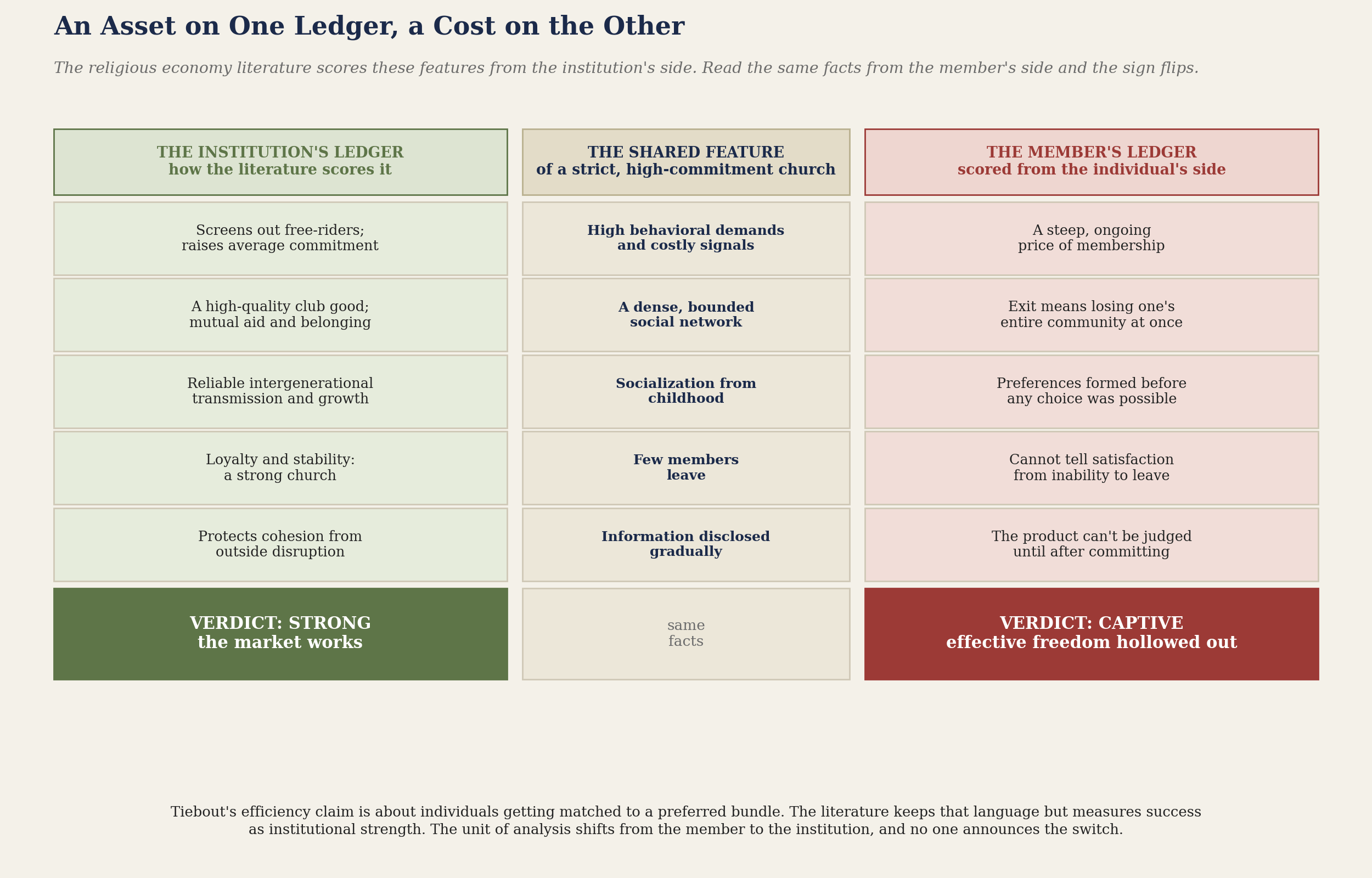
Swap a few nouns and you have the religious economy framework exactly. Households become individuals. Jurisdictions become denominations. Tax-and-service bundles become doctrine, behavioral demands, and community goods. People sort across religions based on preferred bundles, competition disciplines the providers, and the equilibrium approximates efficient provision of religious goods. The structures are the same model. The two literatures simply grew up in different rooms and never compared notes. Iannaccone’s own survey of more than 200 papers in the economics of religion contains zero references to Tiebout.
That gap matters because of what happened to the Tiebout model after 1956.
Every market model carries its own failure conditions
Tiebout’s result holds only under a specific set of assumptions, and he was honest about them. Consumers have to be perfectly mobile, with zero relocation costs. They need complete information about every bundle on offer. There has to be a large enough number of jurisdictions to cover the range of preferences. Preferences have to be exogenous, meaning they exist before sorting and are not produced by the jurisdiction itself. When those assumptions hold, the equilibrium is efficient. When they do not, it is not.
The forty years of work after Tiebout were largely about cataloguing when they do not. The equilibria turn out to be efficient only under restrictive conditions that rarely obtain (Bewley, 1981), and the empirical predictions do not hold cleanly even in the municipal setting the model was designed for (Rhode and Strumpf, 2003). The literature converged on four systematic ways competitive sorting breaks down: mobility costs, preference endogeneity, thin markets, and information asymmetry.
This is the part the religious economy framework imported the conclusion of without importing the conditions. If you are going to use the market model to argue that religious competition produces good outcomes, then you have inherited the entire apparatus, including the parts that specify when it does not. You do not get to keep the efficiency result and discard the failure conditions. They are the same theorem.
So apply them to religion. All four map over, and several map over with more force than they ever had for towns.
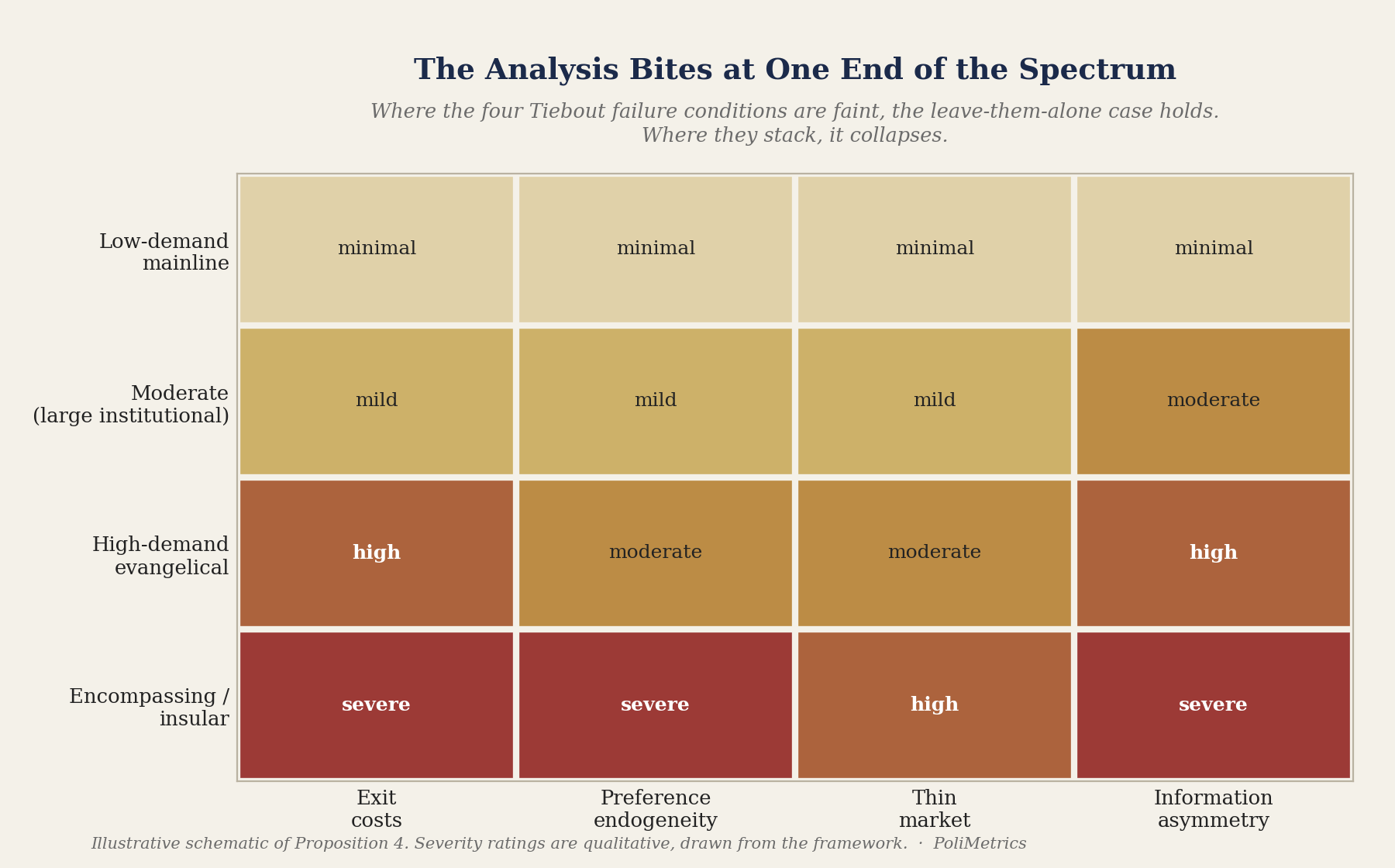
Mobility costs. Moving towns is expensive: a new mortgage, a new commute, uprooted kids. Leaving a high-demand religion can be far worse, and the costs are largely non-monetary. Exit can mean family rupture, the loss of your entire social network, the collapse of the identity and moral framework you were raised inside, and in some cases the loss of employment and housing tied to the community.
The evidence here is not anecdotal. People who leave high-cost groups, the LDS Church and Jehovah’s Witnesses named specifically, report worse health than people who stay or who leave low-cost mainline denominations (Scheitle and Adamczyk, 2010; Fenelon and Danielsen, 2016). Formal shunning produces long-term effects on depression and life satisfaction that look like the loss of a primary support system (Luther, 2023; Ransom et al., 2021). These are exit costs. In Tiebout terms, they are the friction that prevents the disciplinary mechanism from working.
Preference endogeneity. Tiebout assumes you show up with preferences already formed. That is fine for an adult convert who shopped around. It is false for the modal religious adherent, who was born into the religion and socialized into it before having the cognitive or emotional resources to evaluate anything. When an institution forms your preferences from childhood through immersion, information restriction, emotional conditioning, and identity fusion, the causal arrow runs backward. The institution produced the consumer. At that point “high member satisfaction” cannot be read as evidence of a good market match. It might just be adaptive preference. You learned to want what you were given because you were never shown the alternatives in a form you could assess. The revealed-preference logic the whole framework leans on quietly fails.
Thin markets. The model needs enough providers to make choice meaningful. Plenty of religious consumers do not have that. A single denomination dominating a region, evangelical Protestantism across much of the rural South or Catholicism in parts of Latin America and Southern Europe, produces an effective monopoly that nominal pluralism hides. When the social cost of being the only person in town outside the dominant church is high, the exit option exists on paper and not in practice.
Information asymmetry. Tiebout assumes you can see every bundle clearly. High-demand religions are built the opposite way. They reveal doctrine and obligation gradually, disclosing the full scope of commitment only after you have made the public commitments that raise your exit costs. Religious membership is an experience good with high switching costs, which industrial organization recognizes as one of the most failure-prone combinations there is. You cannot evaluate the product until after you have consumed it, and by then leaving is expensive.
The irony at the center
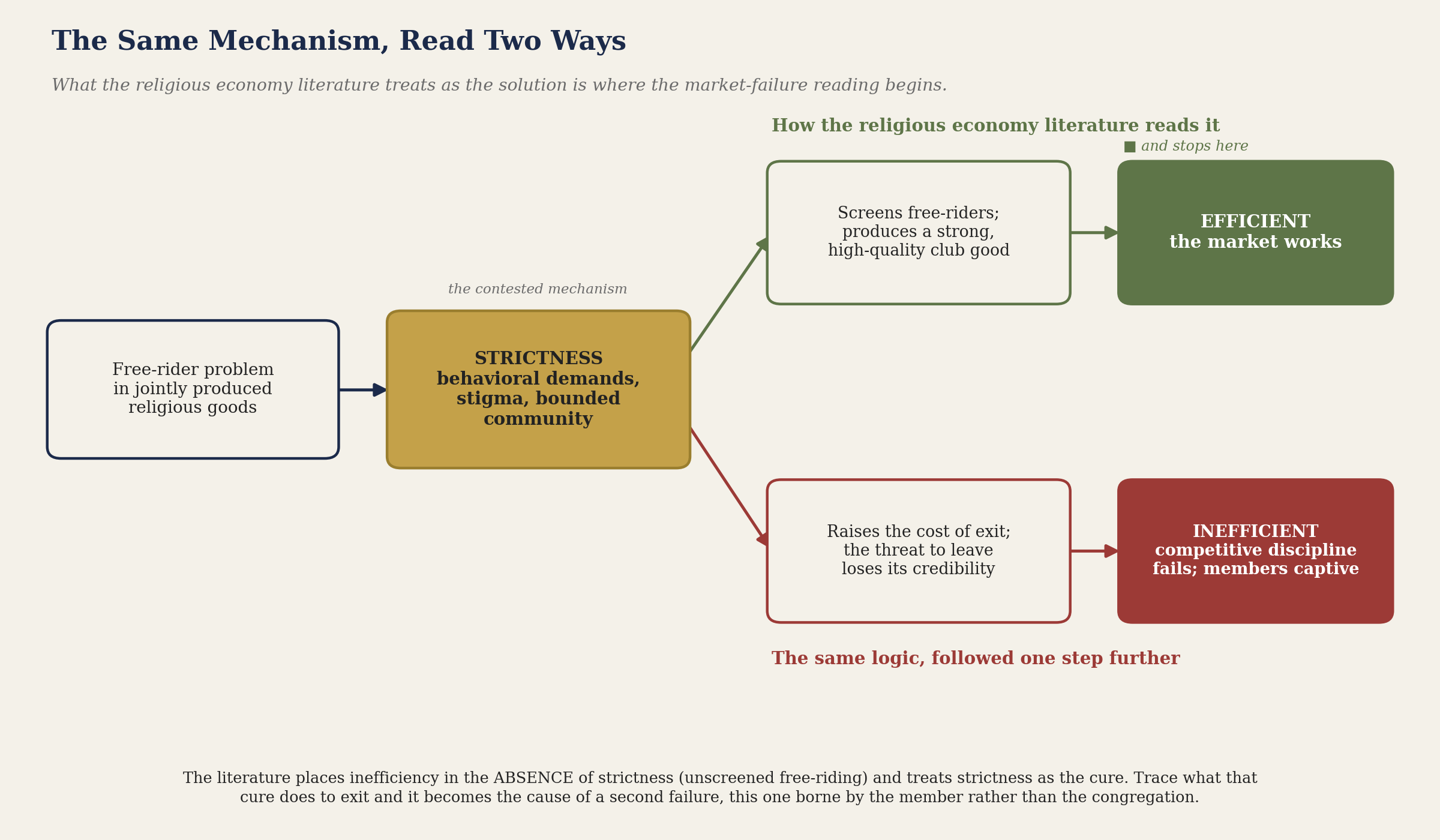
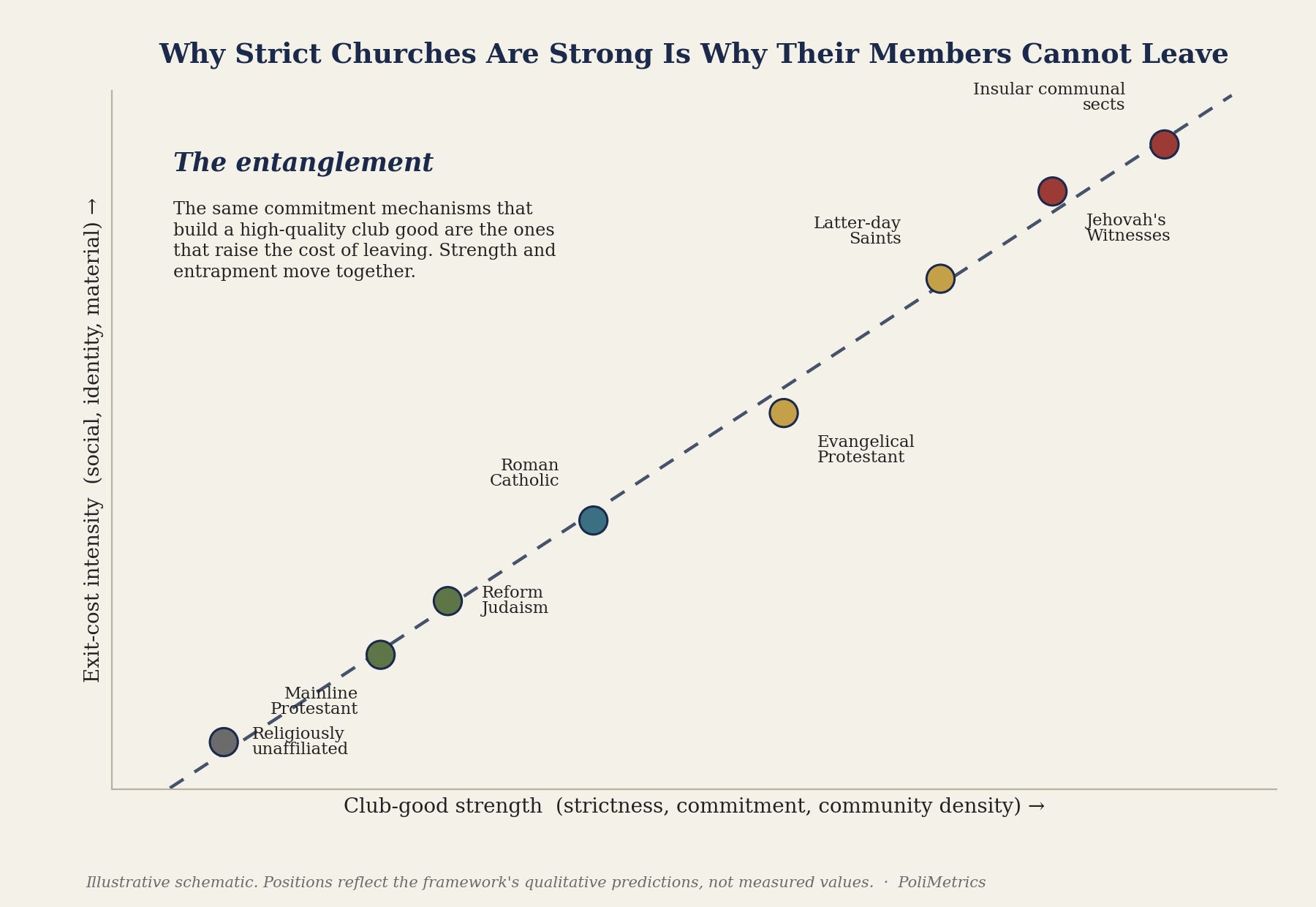
A celebrated result of this literature is that strict churches are strong because strictness solves the free-rider problem (Iannaccone, 1994). The behavioral prohibitions, the stigma, the costly signals, the bounded community: all of it screens out low-commitment members and invests the rest in a high-quality club good. But every one of those mechanisms is also an exit cost. The concentrated social network you cannot replace, the identity you cannot separate from, the distinctiveness that isolates you from outsiders: the same features that produce a high-quality club good are the ones that make leaving catastrophic.
So the club-goods result and the market-failure result describe the same structure from two angles. The more completely a religion solves its free-rider problem, the more completely it disables the competitive mechanism that is supposed to discipline it. The strongest churches are, by the framework’s own logic, the ones the market can least correct. A complete religious economy theory has to explain not only why strict churches are strong, but why their strength switches off the discipline the model assumes is always running.
This is also where exit, voice, and loyalty become unavoidable. The three are supposed to work together: loyalty slows exit and gives voice room to operate. But when exit costs get high enough, loyalty stops being a healthy delay and becomes a trap (Hirschman, 1970). Voice gets suppressed instead of activated, because the institution knows the dissatisfied cannot credibly leave. It has no reason to listen. That is the equilibrium high-demand religions actually occupy.
Why the lens matters
None of this argues for regulating belief, which is protected and which nothing here touches. The argument is narrower. The case for leaving these institutions alone is a market case, and market cases hold only when market conditions hold. In the high-demand, high-exit-cost, locally monopolistic institutions where all four conditions fail at once, the "members can always leave" defense collapses, because the leaving it assumes is exactly what the exit costs foreclose. The legal right to leave stays intact. The practical freedom to act on it does not, hollowed out by the same mechanisms that make the institution strong (Okin, 1999, 2002).
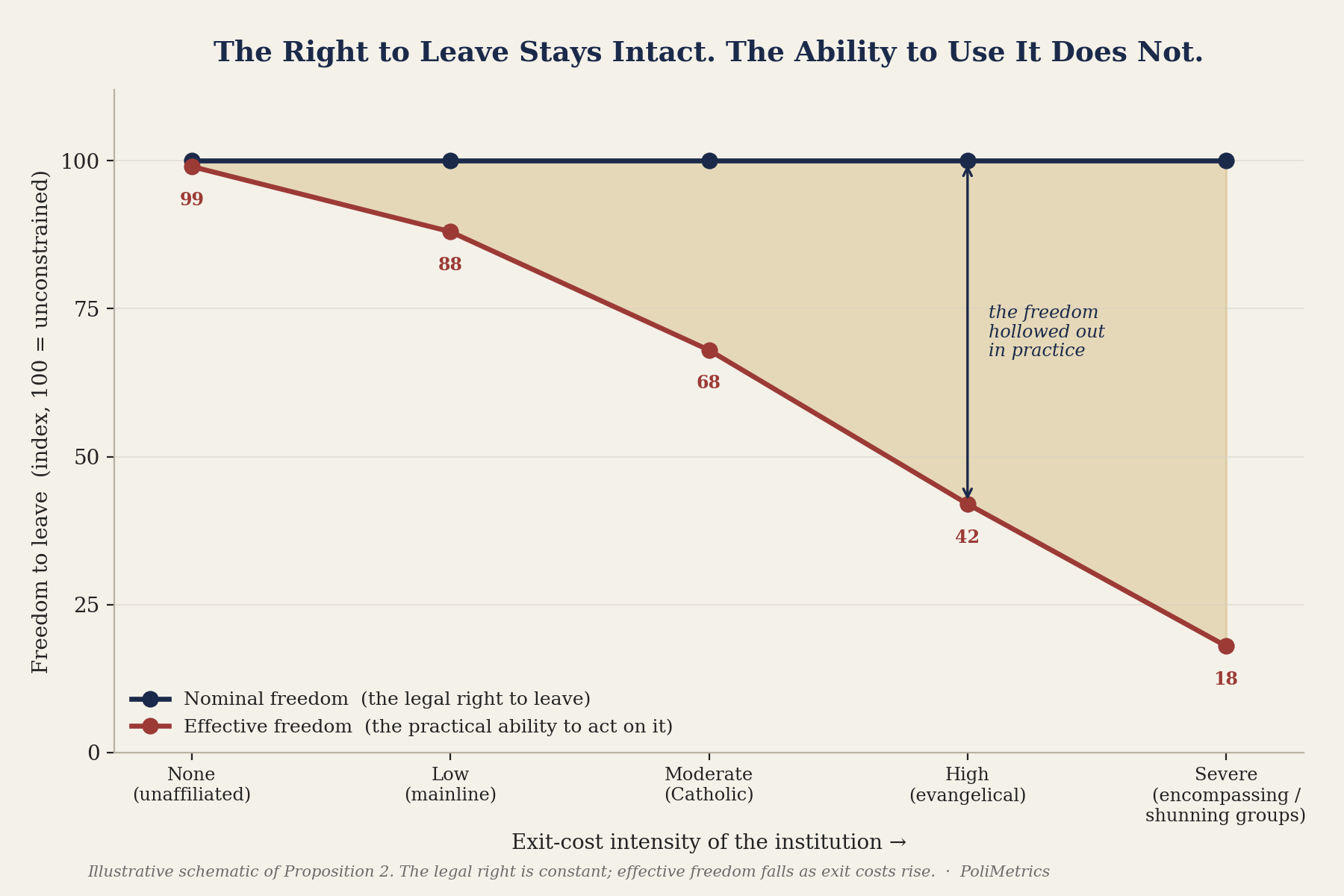
None of this has to be deliberate. The exit costs are a byproduct of the club-good features that solve the free-rider problem, and an institution need not intend that result for the structure to produce it. What it produces is an autonomy that protects institutional power over the members least able to leave, which is the group the autonomy argument claims to speak for.
This does not condemn religion, and it does not treat all denominations alike. Low-demand groups with porous boundaries and accessible exit approximate the conditions under which leaving them alone is sound. The analysis bites only at the other end, and it bites using the framework’s own logic: the same rational-choice method that justifies leaving a functioning market alone justifies scrutiny when the market fails. My complaint with the people who use the framework is that they stop halfway, keeping the half that protects institutions and dropping the half that holds them accountable.
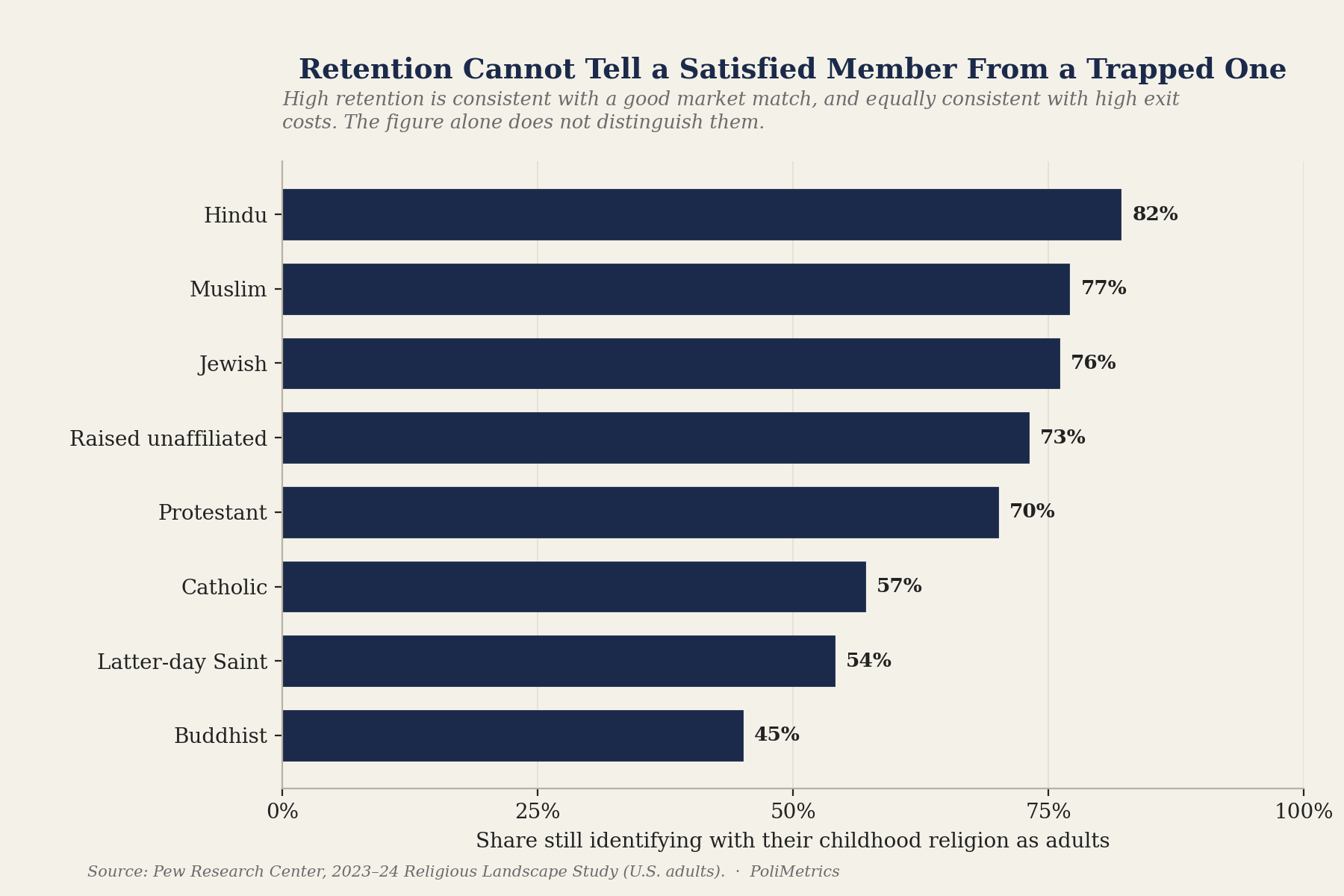
The deeper point is that the religious economy literature only ever borrowed half of Tiebout. It took the sorting intuition and left behind the public finance machinery built to analyze institutions like these.
A denomination collects a tax, delivers local public goods, sets provision through a hierarchy rather than a vote, and makes leaving expensive. Functionally that is a jurisdiction, and one where neither the ballot nor the exit works.
Run the public finance diagnostics on it and the questions get concrete: can it raise its demands without losing members, who pays in more than they get back, and does provision track what members want or what the hierarchy wants as exit gets costlier?
The data exists. The questions just haven't been asked with this framing, because the literature studies churches as firms competing for adherents rather than as the governments they functionally are.
That is the work the next posts take up.