
Why Enforcement Accountability Isn’t an Immigration Debate
Holding ICE Accountable

Here’s something I think is really important to understand.
You can want strict immigration limits AND demand humane enforcement. You can support generous immigration AND expect agencies to follow court orders.
These aren’t contradictory positions. Immigration policy and immigration enforcement are two different things:
Immigration policy = How many visas we issue, what categories we prioritize, asylum eligibility, pathways to citizenship
Enforcement standards = Whether agencies follow the law, respect human rights, operate with oversight, and treat detainees humanely
But the debate has been deliberately collapsed into a false binary: if you criticize ICE, you must want open borders. That’s false. Opposing torture doesn’t mean opposing enforcement. Demanding accountability doesn’t mean eliminating borders.
Regardless of where you stand on immigration numbers, visa quotas, or border security, we should all agree that federal enforcement agencies must:
Follow court orders
Provide basic medical care to people in custody
Not torture detainees
Operate with meaningful oversight
Not shoot people based on fabricated claims
Keep people alive while they’re detained
The data shows ICE is failing these standards systematically. Not in isolated incidents. Not at a few problematic facilities. Across the entire agency, in ways that suggest deep institutional dysfunction.
Let me show you the evidence.
Part 1: The Scale of Operations is Growing Rapidly
ICE’s enforcement operations have expanded dramatically since 2024.
Arrests:
Convicted Criminal: Individuals with a final criminal conviction in the U.S. (misdemeanor or felony). This includes convictions that may be minor (e.g., traffic offenses, shoplifting) as well as serious crimes. ICE counts any criminal conviction, regardless of sentence served or severity.
Pending Criminal Charges: Individuals who have been arrested or charged with a crime in the U.S. but have not yet been convicted. This includes people awaiting trial, in pre-trial proceedings, or with unresolved criminal cases. Note: They are presumed innocent under U.S. law.
Other Immigration Violator: Individuals arrested solely for civil immigration violations (e.g., overstaying a visa, entering without authorization, or violating terms of admission). These individuals have no criminal charges or convictions. Immigration violations are civil, not criminal, offenses under U.S. law.
Important context to note:
The “Convicted Criminal” category doesn’t distinguish between a DUI from 10 years ago and violent crimes
“Pending Criminal Charges” includes people who are legally innocent until proven guilty
“Other Immigration Violator” represents people with zero criminal involvement. They’re in civil detention for immigration status alone
Detentions:
This surge in enforcement activity provides important context for what follows. As operations scale up, we need to ask: are oversight mechanisms scaling proportionally?
The answer is no.
Part 2: Deaths in ICE Custody Are Trending Upward
This upward trend in deaths demands explanation. Are detention conditions worsening? Is medical care deteriorating? Are people being detained longer or in worse health? Are detention facilities becoming overcrowded? The available evidence suggests all these factors are at play.
Part 3: Oversight Systems Are Failing By Design
In May 2025, the Government Accountability Office (GAO) released a damning report on ICE detention facility inspections. The findings reveal a system that appears designed to produce passing grades rather than meaningful accountability.
The Tale of Two Inspection Systems
Between fiscal years 2022-2024, two different DHS entities inspected immigration detention facilities and reached wildly different conclusions:
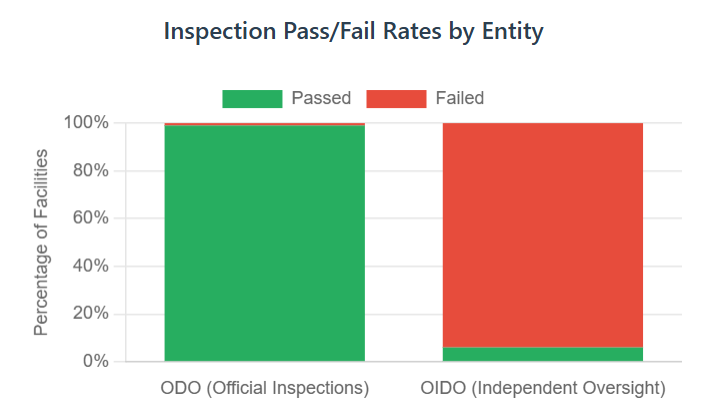
ICE’s Office of Detention Oversight (ODO):
Rated 238 of 241 facilities (99%) as “acceptable” or higher
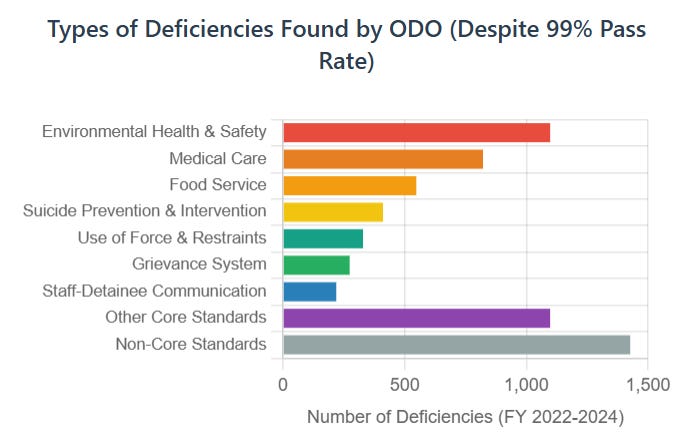
Despite these passing grades, identified 5,493 deficiencies across these same facilities
Deficiencies included failures in environmental health and safety (water quality, sanitary conditions), medical care, food service, and suicide prevention
The Immigration Detention Ombudsman (OIDO):
Found 31 of 33 facilities (94%) were NOT in compliance with the specific standards they examined
These were targeted inspections based on complaints, meaning facilities failed to meet standards related to the very issue that triggered the investigation
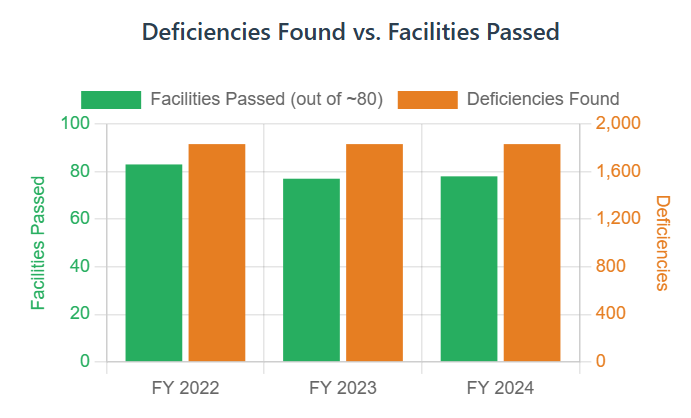
This isn’t a small discrepancy. It shows two different approaches to oversight. ODO’s inspections serve as the official “inspection of record” that determines whether facilities can continue operating. OIDO conducted independent investigations of specific problems.
Then OIDO Was Eliminated
In March 2025 (the year detention deaths spiked to 31) DHS dissolved the Immigration Detention Ombudsman’s office. The independent oversight body that was actually finding non-compliance was eliminated, leaving only the entity that passes nearly everyone.
Gaming the System
ICE has developed sophisticated strategies to avoid accountability. Since 2009, federal law has prohibited ICE from continuing contracts with facilities that fail two consecutive inspections. But ICE has found ways around this:
Clay County Jail, Indiana (2021): After failing a May 2021 inspection, ICE gave the facility extra time to prepare for its follow-up. When inspectors found conditions still “unacceptable” in December 2021, ICE certified the facility as compliant anyway, allowing the contract to continue. NIJC’s lawsuit revealed that people detained there experienced medical neglect, insufficient food, freezing conditions, and sexual abuse.
Lexington County Detention Center, South Carolina (2023): After the facility failed its February 2023 inspection, ICE claimed that because the contract didn’t specify which standards applied, the failure was “for informational purposes only”, meaning a second failure wouldn’t trigger contract termination.
No Way to Measure if Oversight Works
The GAO found that none of the three main inspection entities had established performance goals or measures to assess whether their inspection programs were effective. There’s literally no system in place to determine if inspections are making facilities safer or just creating paperwork.
As the GAO noted, this means DHS and ICE leaders lack the information needed to “make well-informed decisions to manage and adjust inspection activities and use resources effectively.”
Recommendations Are Ignored
Even when oversight bodies recommend closures, ICE frequently ignores them:
The Office for Civil Rights and Civil Liberties (CRCL) recommended in August 2021 that Winn Correctional Center in Louisiana be “closed or drawn down” due to horrific conditions. ICE continues to detain people there today.
The DHS Office of Inspector General issued a report in March 2022 recommending ICE immediately stop detaining people at Torrance County Detention Facility in New Mexico. ICE rejected the recommendation. That August, Kesley Vial, a 28-year-old man from Brazil, died by suicide in the facility, failures identified in the OIG report contributed to his death.
Deliberate Concealment
Information about dangerous conditions is systematically hidden from public view. In August 2023, NPR reported that CRCL investigations showing “barbaric conditions” in ICE detention were kept secret for years. The Project on Government Oversight noted that by shielding these records, “DHS can conceal problems for years, if not indefinitely.” These things were being said in 2023, when Biden was still in office. Imagine what they’ve deteriorated to now.
This isn’t a system experiencing dysfunction, it’s a system operating exactly as designed, prioritizing contract continuation over human safety.
Part 4: Cruelty is the Brand
The oversight failures documented above aren’t just bureaucratic dysfunction, they enable and conceal systemic abuse. To understand what happens when accountability disappears, we need to look at what ICE detention has become under the current administration.
“Alligator Alcatraz”: Cruelty as Marketing
In June 2025, Florida opened what would become one of the most emblematic detention facilities of this era. Built in just eight days in the Florida Everglades, the facility was officially branded “Alligator Alcatraz” by state officials, a name designed to emphasize isolation and intimidation.
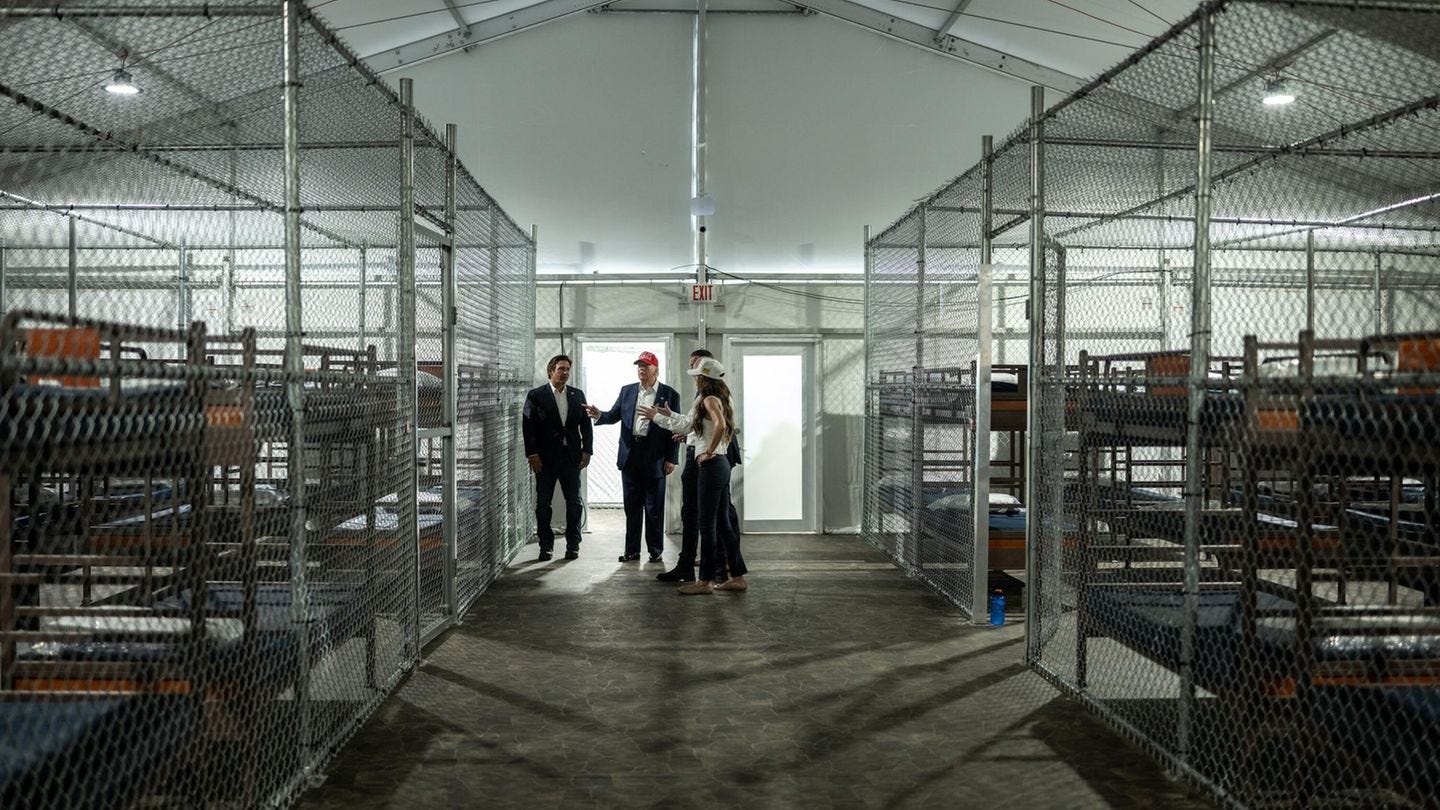
President Trump joined Florida Governor Ron DeSantis and DHS Secretary Kristi Noem for the July 1 opening ceremony. Trump praised it, saying “It might be as good as the real Alcatraz,” adding it’s “a little controversial, but I couldn’t care less.”
The Republican Party of Florida immediately began selling merchandise. Hats, shirts, and koozies with AI-generated images. Conservative influencers received “official Alligator Alcatraz merch” from the state. The administration was marketing a facility where hundreds of people were held without criminal charges.

The Reality Behind the Brand:
Congressional representatives who toured the facility in July reported:
Hundreds of migrants confined in cages amid 90-degree heat
Severe bug infestations
Meager meals, with reports of maggot-infested food
Denial of access to potable water
Detainees shouting for help and crying “libertad” (freedom)
Attorneys unable to reach clients due to remote location
On July 25, Governor DeSantis claimed “everybody here is already on a final removal order.” NBC6 Investigates obtained ICE data showing this was false: only 31% had final removal orders. Nearly 70% did not. The governor’s office declined to explain the false statement.

“Enforced Disappearances”:
By late August, approximately 800 of 1,800 detainees who had been held at Alligator Alcatraz had disappeared from ICE’s online database. Another 450 showed “Call ICE for details.” Families and attorneys couldn’t locate them.
Thomas Kennedy of the Florida Immigrant Coalition described it as “administrative disappearances,” noting the facility operates “as an extrajudicial black site, completely outside of the previous models of immigration detention in this country.”
Human Rights Findings:
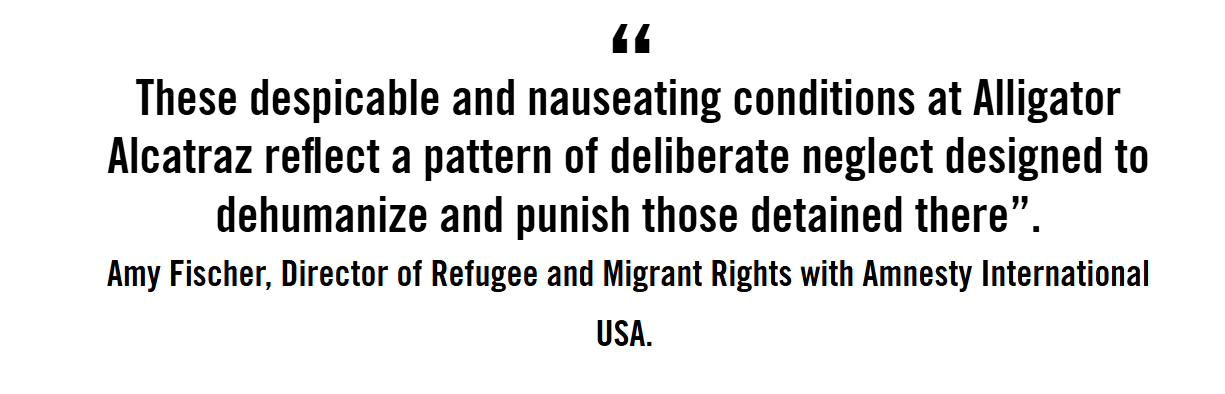
Amnesty International’s December 2025 report concluded: “Detention conditions at both facilities [Alligator Alcatraz and Krome] amount to cruel, inhuman and degrading treatment. The use of prolonged solitary confinement at Krome and the use of the ‘box’ at Alligator Alcatraz amount to torture or other ill-treatment.”
A federal judge issued a preliminary injunction in August 2025 ordering the administration to stop construction and remove infrastructure within 60 days, citing environmental law violations. Florida officials said they would keep operating despite the court order.
The facility is projected to cost $450 million annually, more than the entire budget of many federal programs.
Similar Patterns Nationwide:
Alligator Alcatraz represents an extreme, but the conditions it exemplifies appear throughout the detention system. A 107-page investigation of Louisiana ICE facilities documented physical and sexual abuse, denial of adequate food and water, unsanitary conditions, and denial of medical treatment, conditions that investigators concluded met the legal definition of torture for some detainees. At New York’s Batavia facility, Inspector General reports found 150 specialty medical appointments backlogged and routine use of force against detainees who posed no threat.
CECOT: The International Model
If Alligator Alcatraz represents the administration’s domestic vision, CECOT (the Terrorism Confinement Center in El Salvador) represents its international ambitions.
The Deal:
In February 2025, Secretary of State Marco Rubio visited El Salvador to meet with President Nayib Bukele, who styled himself the “world’s coolest dictator.” Bukele offered to house “dangerous American criminals, including U.S. citizens and legal residents” at CECOT for a fee. The Trump administration accepted, paying $6 million to imprison deportees for one year.
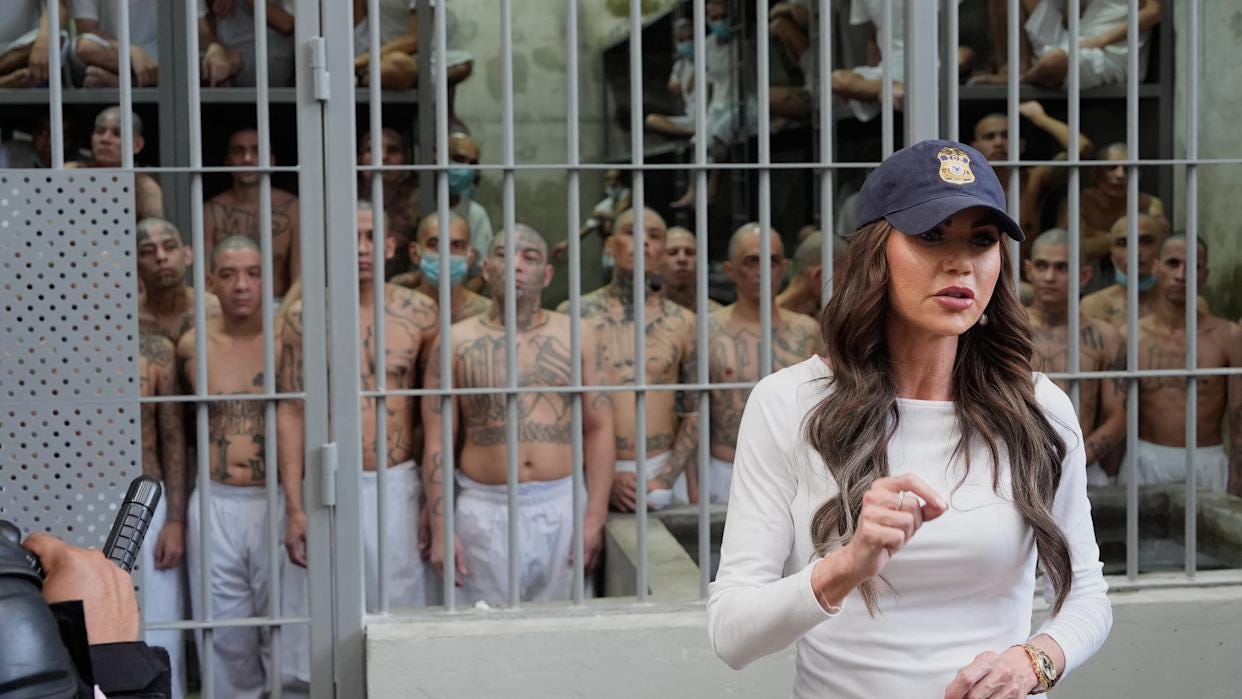
CECOT is the largest prison in the Americas, with capacity for 40,000 inmates. CNN reporters who visited described cells “built to hold 80 or so inmates” where men are held 23.5 hours a day with no mattresses, sheets, or pillows. Lights stay on 24/7. There are no family visits, no outdoor recreational space, and no rehabilitation programs. Prisoners receive an average of 0.6 square meters of space, far below the international standard of 3-6 square meters.

El Salvador’s Justice Minister stated that prisoners at CECOT “will never return to their communities.”
The Choreographed Cruelty:
When the first deportation flight arrived in March 2025, Bukele released promotional videos showing men stripped to white boxer shorts with shaved heads, officers forcing detainees to run into cells, and shackled men bent at the waist with guards pushing their heads down.
Secretary of State Marco Rubio retweeted the video, thanking Bukele for his “assistance and friendship.”
DHS Secretary Kristi Noem visited CECOT in March 2025, recording a message while standing in front of a cell packed with prisoners: “If you come to this country illegally, this is one of the consequences you may face.”
During an April 2025 Oval Office meeting, Trump suggested Bukele should “build about five more places” like CECOT. Trump even floated deporting “heinous, violent criminals” who were American citizens to El Salvador, despite no legal authority for such action.
The Reality vs. The Propaganda:
Despite administration claims that deportees were dangerous gang members, investigative reporting revealed:
At least 60 were seeking asylum in the U.S.
Three-fourths had no apparent criminal record
Many were long-time U.S. residents with citizen spouses and children
Deportation occurred without due process
Human Rights Documentation:
A December 2025 report by Human Rights Watch and Cristosal found the treatment of Venezuelan deportees at CECOT amounted to arbitrary detention and enforced disappearance under international law. Investigators documented constant beatings, sexual abuse, and torture.
As one survivor described: “When you get there, you already know you’re in hell.”
Human Rights Watch documented at least 261 people died in El Salvador’s prisons during Bukele’s gang crackdown between 2022-2024.
Federal Judge Finds Due Process Violations:
U.S. District Judge James Boasberg ruled in June 2025 that the deportations deprived men of their constitutional rights and called their plight “Kafkaesque.” He found probable cause to hold the Trump administration in criminal contempt for deliberately violating his court orders, noting officials “defied the court’s order deliberately and gleefully”, citing Rubio’s retweet of Bukele’s post boasting about the defiance.
The Pattern:
Both Alligator Alcatraz and CECOT reveal something beyond policy disagreement. These facilities represent a deliberate choice to:
Brand and market cruelty as a positive
Create conditions that meet the international definition of torture
Celebrate rather than conceal abuse
Use slick videos and photo ops to promote inhumane treatment
Operate facilities as extrajudicial sites beyond normal oversight
Lie to the public about who is detained
Ignore court orders requiring humane treatment
This isn’t enforcement, it’s spectacle. And it’s being held up as a model.
Part 5: Violence and Use of Force Are Escalating Dramatically
Perhaps most alarming to the average American is the spike in ICE shootings since the current administration’s enforcement surge began.
The Numbers
According to data compiled by The Trace and confirmed by multiple news outlets:
Since June 2025 (Trump’s second term):
16 shooting incidents by ICE and Border Patrol agents
4 deaths
At least 7 injuries
15 additional incidents where agents held people at gunpoint but didn’t shoot
14 incidents using “less-lethal” weapons (tasers, rubber bullets, pepper balls)
For comparison:
In all of fiscal year 2023, DHS reported only 5 gun-related use-of-force incidents by ICE
That’s a 220% increase in the rate of shootings
Three of the four deadly shootings occurred in a single month (December 2025-January 2026).
The Pattern of Disputed Claims
What makes this escalation even more troubling is the pattern of federal claims of “self-defense” that are contradicted by video evidence and eyewitness testimony:
Renee Good (Minneapolis, January 2026): Federal officials claimed she tried to run over an agent. Video shows her turning her vehicle away to leave when an agent opened fire. Minneapolis Mayor Jacob Frey called the self-defense claim “bullshit.”
Marimar Martinez (Chicago, October 2025): Prosecutors claimed the officer shot in self-defense after Martinez tried to ram agents. Her attorneys showed footage revealing that agents had rammed her car. Charges were dismissed.
Chicago shooting (October 2025): After shooting a woman multiple times, the Border Patrol agent reportedly texted: “I fired 5 rounds, and she had 7 holes. Put that in your book boys.”
This isn’t just about whether individual shootings were justified. It’s about an institutional pattern of violence followed by false official narratives.
Beyond Shootings: A Culture of Aggression
Federal immigration agents have also:
Pointed guns at Illinois State Representative Hoan Huynh while he was informing community members of their rights
Pointed a gun at a pregnant woman after she honked her horn to alert people ICE was nearby
Allegedly pointed a gun at a combat veteran while saying “bang, bang” and “you’re dead, liberal”
Fired pepper balls at reporters and legal observers
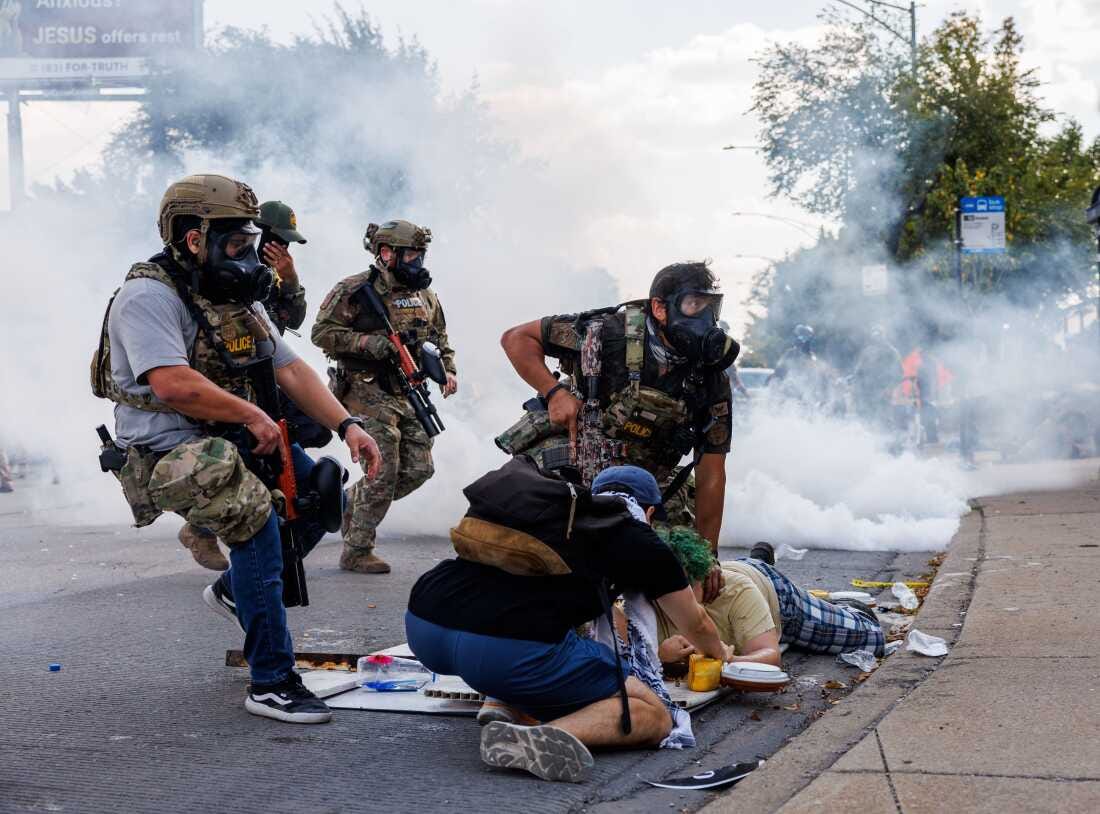
NPR documented incidents of people being tackled, pepper-sprayed, and tear-gassed. ACLU officials note a “general escalation of violence and the use of excessive force.”
Part 6: Constitutional Violations and the Accountability Gap
ICE’s expanding operations have resulted in a surge of civil rights violations and lawsuits, yet meaningful accountability remains elusive.
Wrongful Detention of U.S. Citizens
Multiple lawsuits document ICE detaining and even deporting U.S. citizens:
July 2025: ICE deported three U.S. citizen children to Honduras without parental consent, including a 5-year-old undergoing treatment for stage 4 kidney cancer. ICE held families in hotel rooms, denied them access to attorneys, and refused to let them make arrangements for their children.
Multiple settlements of $150,000 have been awarded for individual wrongful detention cases.
Financial Misconduct
A major class-action lawsuit filed in October 2024 alleges ICE withheld more than $300 million in bond payments from tens of thousands of low-income immigrant families, including some U.S. citizens.
The Systemic Accountability Failure
Despite billions of dollars in claims against ICE, as of 2023 the agency had paid out less than $1 million in settlements.
Why? Several structural factors protect ICE from accountability:
Sovereign immunity protects ICE as an agency from most lawsuits
Courts are increasingly reluctant to extend Bivens remedies (allowing suits against individual federal officers) to immigration enforcement contexts
Prosecution of ICE agents for excessive force is extremely rare
The Federal Tort Claims Act creates procedural hurdles for plaintiffs
Even when courts order changes, ICE often ignores them. After a March 2025 settlement in Gonzalez v. ICE required neutral review of detainers in most U.S. states, subsequent evidence showed the government disregarding the orders. A federal judge noted it was “troubling” that the government specifically directed immigration judges to ignore court orders.
What This Means, Regardless of Your Immigration Views
This data show an agency operating beyond the bounds of normal institutional accountability. The pattern is clear across every metric:
The Evidence Shows:
Oversight is cosmetic, not functional: When 99% of facilities pass inspections yet investigators still find torture-level conditions, the inspection system is broken by design.
Violence is escalating without justification: A 220% increase in shooting incidents, with official narratives routinely contradicted by evidence, suggests institutional problems with use-of-force training, supervision, and culture.
Detention conditions are inhumane: Medical neglect, overcrowding despite available capacity, and conditions meeting the legal definition of torture are documented across multiple facilities and time periods.
Cruelty is being celebrated: Alligator Alcatraz merchandise, CECOT photo ops, and administration officials praising torture-level conditions show that abuse isn’t a bug, it’s a feature being actively promoted.
Courts are being defied: When officials gleefully retweet their contempt for federal court orders, we’ve moved past policy disagreements into constitutional crisis territory.
Accountability mechanisms don’t work: Less than $1 million paid out despite billions in claims, structural immunity protections, and ignored court orders create a system where consequences are nearly impossible.
Deaths are increasing: The trend toward 150 deaths in custody for 2026 represents a failure of the agency’s most basic responsibility: keeping people alive while they’re in detention.
This Transcends Immigration Policy
Here’s what makes this an accountability crisis rather than an immigration debate:
You can support strict immigration limits and still oppose an agency that tortures detainees, celebrates cruelty, and ignores court orders.
You can want stronger border security and still demand that facilities provide basic medical care and don’t let people die from neglect.
You can favor deportation of undocumented immigrants and still expect that U.S. citizens won’t be deported without due process.
You can believe in tough enforcement and still reject officials who market torture as merchandise and hold photo ops at foreign prisons.
These aren’t contradictory positions. They’re what it looks like to support immigration enforcement AND respect the Constitution. The administration wants you to think opposing ICE’s abuses means supporting open borders. That’s a false choice designed to prevent accountability.
The Founders built America because they’d lived under governments that could arrest you in the night and you’d disappear. That imprisoned people without trial. That had secret detention. That operated beyond the law.
So they wrote a Constitution that said: No more.
They said no official can ignore a court. No government has the right to indefinite detention or torture or making people vanish.
Now look at what ICE has become.
Sources & Further Reading
Official Government Reports
Civil Rights & Advocacy Organizations
National Immigrant Justice Center: ICE’s Abusive Detention Inspection System (2023)
Amnesty International: Human Rights Violations at Alligator Alcatraz and Krome (December 2025)
Human Rights Watch & Cristosal: Treatment of Venezuelan Deportees
Investigative Journalism
Investigative Post: Use of Force Violations at Batavia Detention Center
ProPublica: Venezuelan Deportees Seeking Asylum Sent to CECOT
Democracy Now: Where Are the Detainees? Alligator Alcatraz Prisoners Disappear
The Intercept: CECOT Is What the Bukele Regime Wants You to See
Legal Analysis & Court Decisions
Slate: Judge Cites Rubio Retweet, Suggests Criminal Contempt
NPR: Federal Judge Rules on Due Process for Venezuelan Deportees
On a previous post, you showed that there are approximately 14 million illegal aliens as of 2023. Detaining only 20,000 per month would take 58 years to remove only the current illegal aliens.
We need far more immigration enforcement presence, which is undebatable. The question is: how should they go about their goal? The best way would be to harshly penalize any and all employers who hire illegals.